

Replacing Cala
Álex Calatrava leaves Castellón after making a remarkable impact over the last two seasons. The club have to replace the 26-year-old and everything he brought to the team.


The first signing of the Monchi era at Espanyol is a good one.
Álex Calatrava was destined to play in LaLiga. Whether that happened with Castellón or somewhere else, the outcome felt inevitable. He has been one of the standout attacking midfielders in Segunda División for the last two years, helping Castellón reach an unlikely promotion play-off place this season and continuing his rise after arriving on a free following his departure from Atlético Madrid B.
Castellón are now left with a difficult, maybe impossible, task in replacing him.
They cannot replace Calatrava like-for-like, of course, and these things never happen in a vacuum. Brian Cipenga, another ever-present for Castellón has left for Almería, upon the expiration of his contract. Beñat Gerenabarrena returns to Athletic Club on loan after a hugely successful spell. There will likely be other departures too.
This is what success looks like for Castellón. They’ll take the funds and the freed up wages from those departures and bet again on undervalued talent. This is the model Bob Voulgaris has built and it’s hard to argue with the results when we see the likes of Calatrava turned from free agent to top flight attacker.
Players who can create, carry, combine, produce in the final-third and handle a heavy workload are not easy to find, especially for a club operating within Castellón’s market. He also worked desperately hard off the ball as is required from all of Castellón players.
So the objective is not to find “the next Calatrava” but to identify players who can reproduce parts of his value, either individually or in the aggregate.
And that is the purpose of this exercise.
The process is simple:
Define what Calatrava gave Castellón.
Decide where we are scouting.
Use clustering and then player ratings model to identify players with similar statistical profiles.
What Calatrava Did Best
According to Goalunit, Calatrava accounted for 48.1% of Castellón’s Transfer KPI, which is a big chunk. Given his performances over the last two seasons, a sale always felt likely. His profile stood out clearly among attacking midfielders and wide creators aged 25 or younger in Segunda División.
He led that group for expected assists per 90 with 0.26. He also ranked first for xT from passing with 0.11 per 90, while ranking second for xT from dribbling behind Yeremay Hernández.
The rarest kind of threat. Calatrava is not just a final-ball player. He added value as a passer, carrier and chance creator. He could receive between lines, progress attacks, draw defenders and still deliver end product while making sure that the defensive side of his game never suffered.
Just as importantly, he proved he could handle volume. Despite being a smaller attacking midfielder, he played 2,232 league minutes in 2023/24 before increasing that to 3,492 minutes in 2024/25. No Castellón outfield player played more minutes this season.
So before looking for replacements, we need to be clear about the profile we are trying to replace. A high-usage attacking midfielder who creates chances, adds threat through both passing and carrying, presses with repeat intensity and can stay on the pitch for almost an entire league season.
Where To Look
Castellón are probably a year ahead of schedule. They are riding a wave of optimism. When Voulgaris said he would take them to LaLiga, many sneered, but that is looking more and more likely with every transfer window under the Greek/Canadian owner.
They are looking for proven talents now and have already signed Juanjo Nieto from NK Celje, Álvaro Martín from Andorra and more will arrive. We decided specifically to look for players in the Primera RFEF, which is more than accessible, and has a lot of underrated players. Although Voulgaris and co. will likely just sign someone from the Latvian 3rd division and blow us out of the water, we focused on the division below where Castellón currently play. Are they the perfect match? No. Is it a shopping list for Castellòn? Also no, but it’s an interesting exercise in defining you scope and scouting players when replacing a star player.
Iván Corralejo Mantero - Betis Deportivo
This one is slightly speculative and would almost certainly have to come through a loan deal. Although Corralejo was one of the players most similar to Calatrava in our model.
The 19-year-old is one of the latest talents to emerge from Real Betis’ academy, and they are unlikely to let him leave permanently given his long-term contract and first-team potential. He has already made his senior debut, which tells you how highly he is regarded internally.
He is similar to the outgoing playmaker but it’s not a clean Calatrava replacement. He does not get into the box as often, he does not shoot much, and he profiles more as a deeper creator than a high-volume attacking midfielder as the video below shows.
Signing him would probably require Castellón to redistribute some of Calatrava’s attacking load across the team but that’s going to happen anyway given Cipenga’s departure and other squad movements.
But this is also what makes him interesting. Corralejo’s value is in his ability to create from central areas. For a player of his age, his vision, technical quality and pass weighting stand out. He sees passes early, can receive in traffic and has the touch quality to connect play through crowded central zones.
The clips below show that technical ceiling. He is not replacing Calatrava’s full attacking output today, but as a loan-market bet, he offers a different route to replacing some of the creative value Castellón have lost.
Roberto Arroyo Gregorio - Osasuna Promesas
Roberto Arroyo was not specifically one of the closest statistical matches to Calatrava in the dataset.
But one aspect of Calatrava’s game that Castellón will want to replace is his work off the ball and that’s where Roberto Arroyo could be just the man. Calatrava had 3.05 opponent half recoveries last season, one of the highest marks in the league among forwards, Arroyo had 2.43.
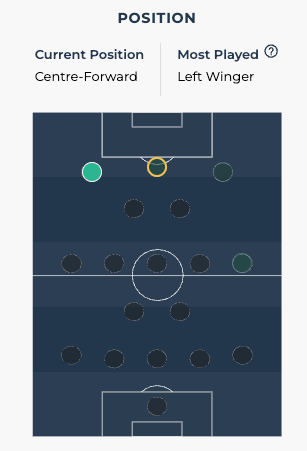
Two seasons ago, Arroyo was used more regularly as a winger. Last season, however, he operated closer to goal, often as a centre-forward or central attacker. That positional flexibility makes him both interesting and harder to sell as a direct Calatrava replacement. He can play across the front line, carries threat in transition with his pace and direct running, attacks space well and gives his team a more physical attacking presence making route one an option.
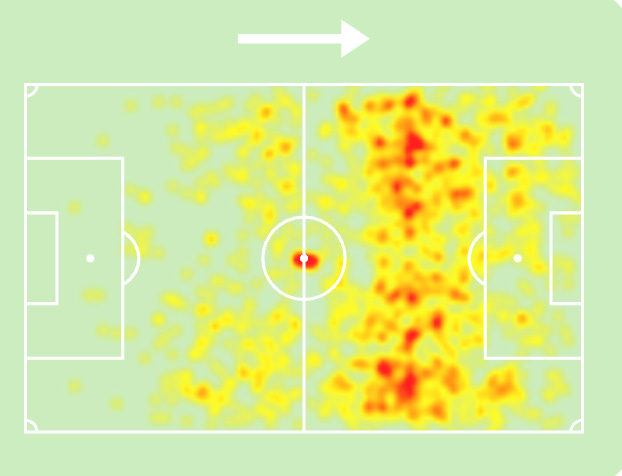
That physical profile is probably the most relevant point from Castellón’s perspective. Calatrava may only be 175cm, but Castellón’s attacking structure still demands aggression and their creative maestro was not exempt. Arroyo brings that naturally. He won 7.5 duels per 90 last season and is comfortable using his frame to protect the ball, absorb contact and compete with defenders.
Despite his background as a winger, Arroyo now operates closer to goal and offers more threat as a deep runner. Last season, he scored four goals from 6.27 xG, or 0.26 xG per 90, while also adding two assists from 2.89 xA, or 0.12 xA per 90.
The underperformance in front of goal is worth noting, but the shot volume and xG numbers suggest he was consistently finding good positions. For Castellón, that could be valuable. Calatrava gave them creativity between the lines while Arroyo would give them more penalty-box presence, more direct running and more physicality in the final third.
The clip below shows Arroyo at his best. He receives the ball under pressure, controlling the ball cleanly, rides the challenge and slides a pass through to the attacker. It is the kind of action that explains why he appears in a Calatrava replacement model, even if they not like-for-like.
The second clip highlights something Calatrava does not really have in his locker but Arroyo can do. He shows off his ability to run beyond the defensive line and use his body to get across the defender. Arroyo is not just a technical creator. He can threaten depth, compete physically and arrive in areas where he can generate shots for himself.
Mehdi Guillermo Puch - Hércules
Mehdi Puch is a slightly different type of attacking midfielder to Calatrava. He was classified as a ‘hybrid profile’ in our model meaning he didn’t fit neatly into any primary cluster.
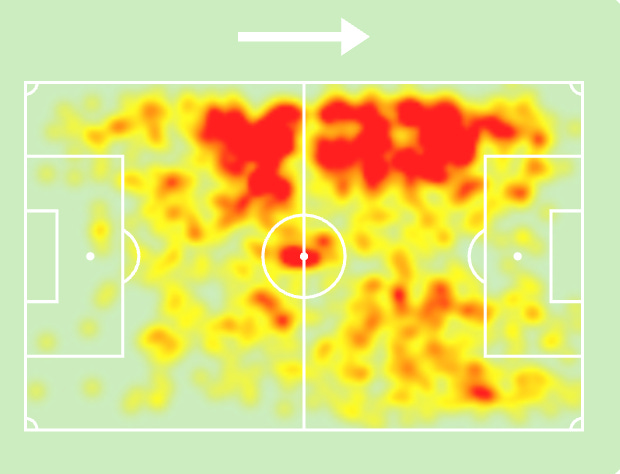
Where Calatrava usually started from the right before drifting inside, Puch plays more on the left and drifts centrally. He is not necessarily the player who provides the final pass before the move is finished. He is more often the player who carries or combines his team into the final third.
If Roberto Arroyo offers a more physical, box-oriented version of the profile, Puch offers something closer to a central progression piece.
The 22-year-old is one of the more interesting under-23 players in Primera RFEF. He came through Ajaccio’s academy and made his Ligue 1 debut with the club in 2022/23 before moving to Hércules. He has pedigree and made a breakthrough in one of the most competitive leagues in Europe as a teenager.
Puch did not play until January, but once he came into Beto Company’s side, due to bureaucratic problems with his signing. He finished the season with 1,515 minutes, effectively becoming an ever-present during the second half of the campaign.
From a Castellón perspective, the appeal is obvious. Puch is comfortable receiving centrally, turning under pressure and helping his team move into advanced areas. He does not profile as a direct Calatrava replacement in terms of final-ball production, but he does offer value in the earlier phase of attack. He can receive between the lines, carry the ball forward and connect midfield to the final third.
That makes him a different kind of solution. Castellón would lose some of Calatrava’s right-sided creativity and final-third passing, but Puch could help replace his ball-progression value from more central zones. The video below shows his quick thinking and even quicker feet in the penalty area.
He was at or near the top of most counter-pressing recoveries and opponent half recoveries last season too. His reputation is growing. Hércules are expecting interest from higher up the pyramid this summer, and he is under contract until 2029. Watch this space.
As we said, this isn’t a shopping list for Castellón, just some ideas as to younger players coming through in Spain’s third tier. Carlos Segura is another player that could step into more minutes, coming up from the team’s B side but the jump is significant (from Segunda RFEF to the second tier).
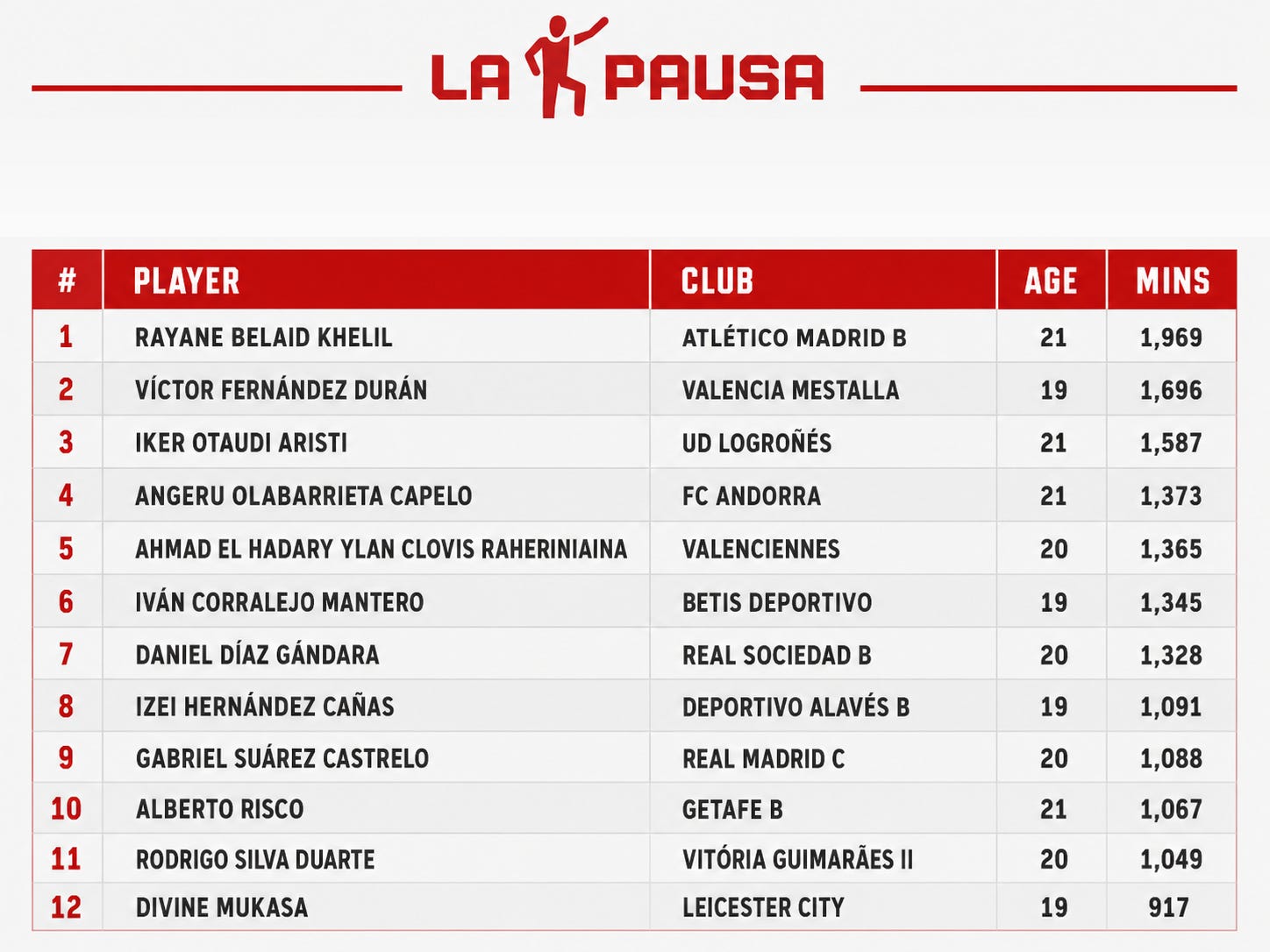
Note: below is a list of some of the other names to keep an eye on coming through. We included a lot of different leagues in the model so that’s why you see a player from Leicester and from Valenciennes.
Love La liga as well my second favourite league mate had to subscribe and be great to keep engaging and supporting each other