

How Málaga Got Back On Track
After almost a decade drifting away from LaLiga, Málaga are on the brink of returning to the top flight through a youth-focused strategy and the remarkable impact of head coach Juanfran Funes.


This story could have waited until there was something more tangible to wrap it all up into a neat tale of success. Málaga have not actually achieved anything yet beyond qualifying for the Segunda División playoffs. But the manner in which they have done so is a success story in itself.
Just two years ago, Málaga were playing in Primera Federación, Spain’s third tier. Last season, their first back in Segunda, they finished 16th. The expected next step was to establish themselves in the division, stabilise the club and then, perhaps, make a serious push for promotion further down the line.
Málaga have accelerated that process.
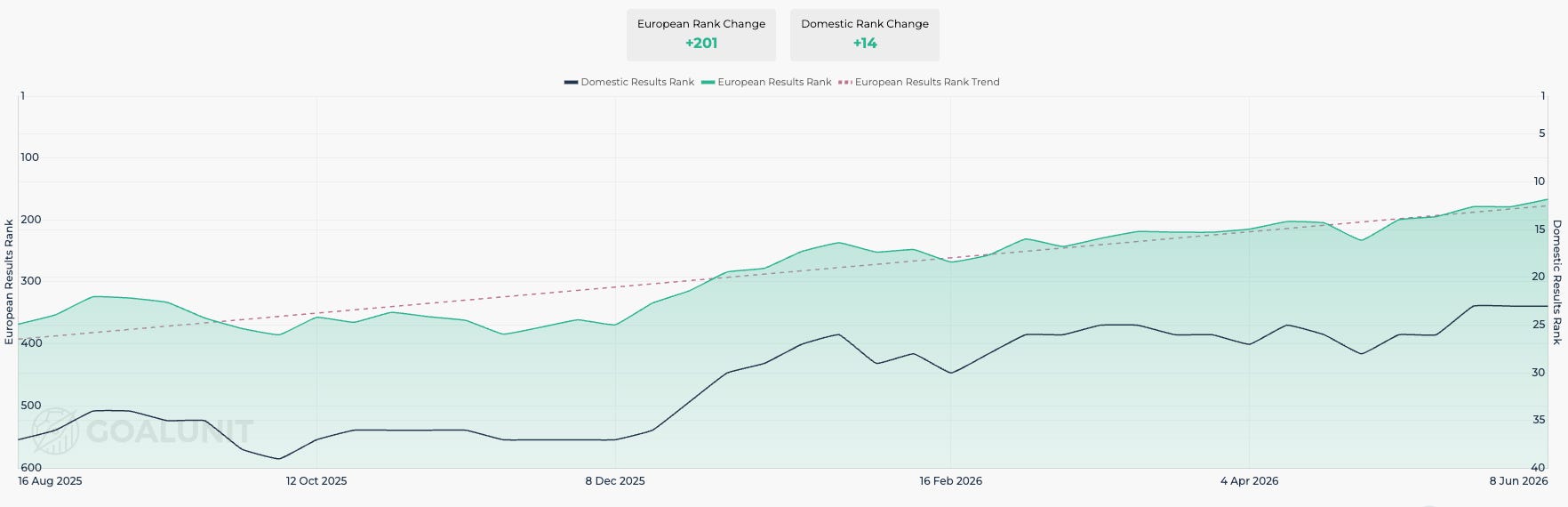
Since the start of the season, they have climbed 201 places in Goalunit’s power rankings and risen 14 places among Spanish clubs to 23rd. Over the past six months, they have outperformed their club-size points benchmark by 0.24 points per match, the fourth-best figure in the division behind only Castellón, Córdoba and FC Andorra.
It is a sharp change in direction for a club that has spent most of the past decade drifting away from the top flight. Málaga played 16 of the first 18 seasons of this century in LaLiga, but finished bottom of the division in 2017–18 and were relegated. They have been out in the cold ever since, eventually falling into the third tier for the 2023–24 season.
Now, less than two years after escaping it, they are within touching distance of LaLiga again.
A Strategy Built From Necessity
The strategy behind Málaga’s rise has centred on the academy and on appointing a coach, Juanfran Funes, who understands the players coming through along with their strengths and weaknesses maybe better than the players understand themselves.
Looking at the numbers shows us this approach may have been driven more by necessity than by a carefully designed long-term plan.
Málaga’s transfer revenue had collapsed over the years. Roberto Fernández was their biggest sale since 2020, a stark contrast with the 2014–15 season, when the club generated around €46 million through the departures of players such as Sergi Darder and Willy Caballero.

The change in strategy can also be seen in the age profile of their recruitment and the number of signings. Málaga’s average signing age was above the league average in five of the first six seasons following relegation from LaLiga. That trend was finally reversed in 2024–25 by a lot. Their average signing age remained below the division’s average last summer even if it did rise.
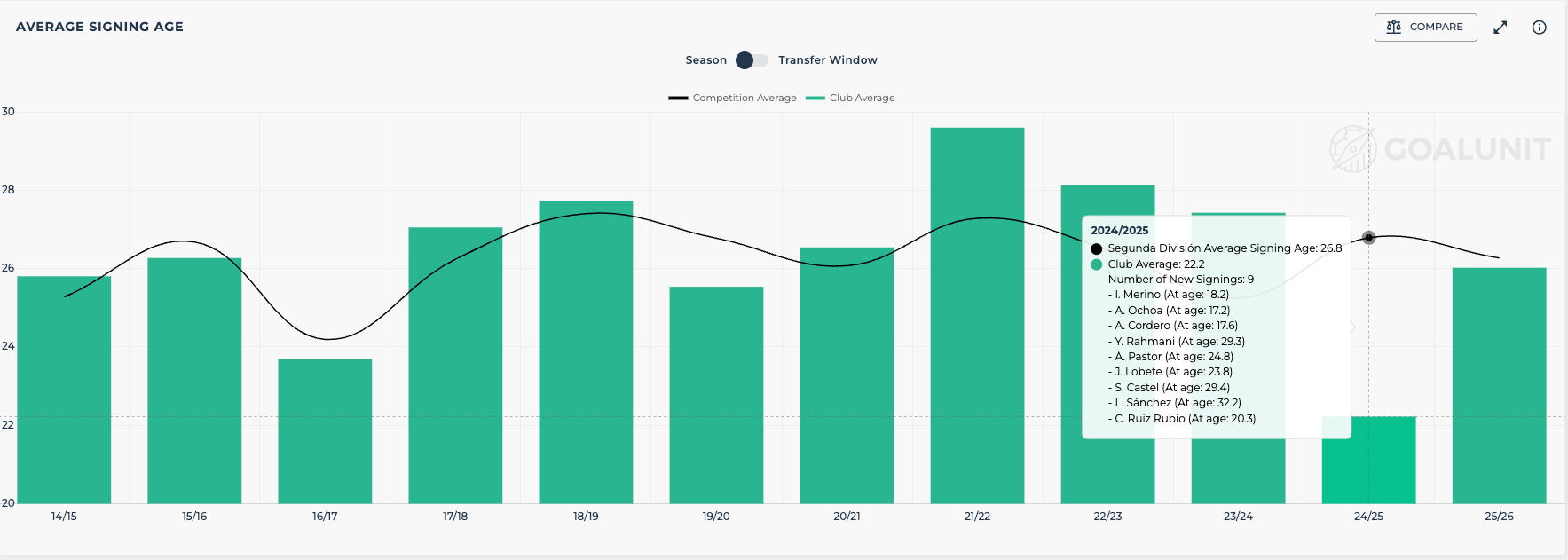
Put plainly, Málaga had run out of alternatives and were forced to turn towards the academy. Fortunately, the academy was producing an unusually strong generation of talent.
Málaga have the second-highest Transfer KPI according to Goalunit (a number signifying a team’s ability to develop talent that might generate future revenue), behind only Real Sociedad B, a team whose primary purpose is to develop players for La Real’s first team. 41% of their playing time has gone to players under 24 years of age, which is sixth-highest in the league.
Chupe, whose full name is Carlos Ruiz Rubio, naturally accounts for a significant part of that figure, but he is far from the only young player emerging.
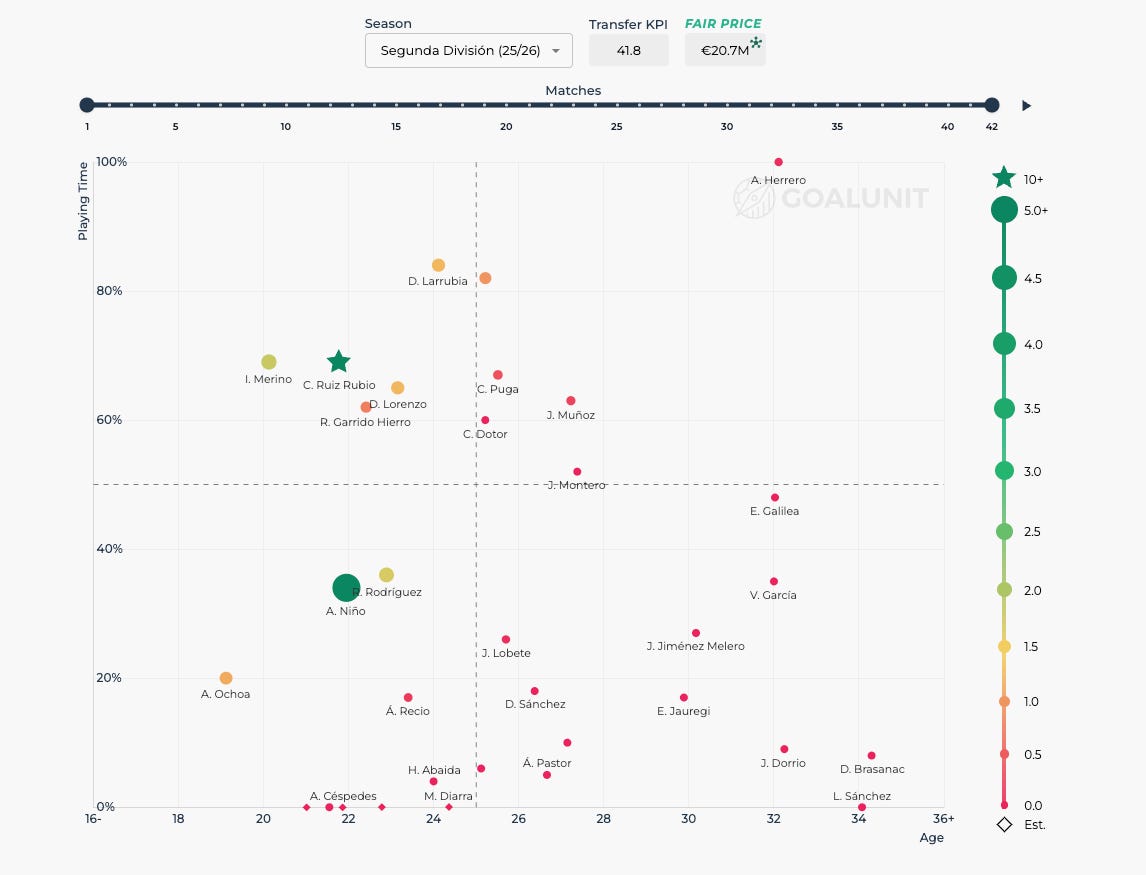
Aarón Ochoa, Izan Merino, David Larrubia, Rafa Rodríguez and Dani Lorenzo are all part of a group that has allowed Málaga to turn a financial limitation into the foundation of a coherent (and successful?) sporting project.
The Captain Of The Ship
Málaga also stopped looking outside the club for solutions on the bench. If the next generation of first-team players was going to come from the academy, there was an obvious logic to appointing the coach who already knew them best. Even if he was only appointed when it became apparent that Sergio Pellicer wasn’t going to get them where they wanted to go.
Juan Francisco Funes had spent the previous five years managing Atlético Malagueño, Málaga’s reserve team, before taking charge of the first team. He understood the players coming through, knew what they could handle and was willing to trust them immediately.
That trust has been central to Málaga’s rise. Since taking over, the 42-year-old has leaned heavily on youth and given academy graduates meaningful roles rather than token minutes.
The impact can also be seen in the value of the squad. Málaga’s players increased in market value by €12.9 million last season, the third-highest rise in the division behind only Racing Santander and Real Sociedad B.
Funes has therefore done more than improve results. He has connected the academy to the first team and turned Málaga’s youth strategy into something tangible on the pitch with an aggressive and effective style of play.
The Style
Málaga are not a possession-dominant side. They have averaged just 51.7% of the ball under Funes, but they are more than capable of playing patiently when the game demands it.
Since Funes took charge, Málaga have ranked among the top two teams in the division for both direct attacks (1st - 2.73 per game) and build-up attacks (2nd - 2.37 per game), a very rare thing to see. That contrast captures the adaptability at the heart of his approach. They can progress methodically from the back or attack space quickly when the opportunity presents itself.
Funes has translated that flexibility into results. Málaga have recorded the third-best expected-goal difference in the division since his appointment, behind only Castellón and Córdoba.
Their fluidity in possession was particularly evident against Las Palmas. Izan Merino regularly dropped into the defensive line to initiate the build-up, while Carlos Dotor and Dani Lorenzo rotated around him depending on where Málaga needed an extra passing option. They can play with a double-pivot, a single pivot and sometimes no pivot at all.
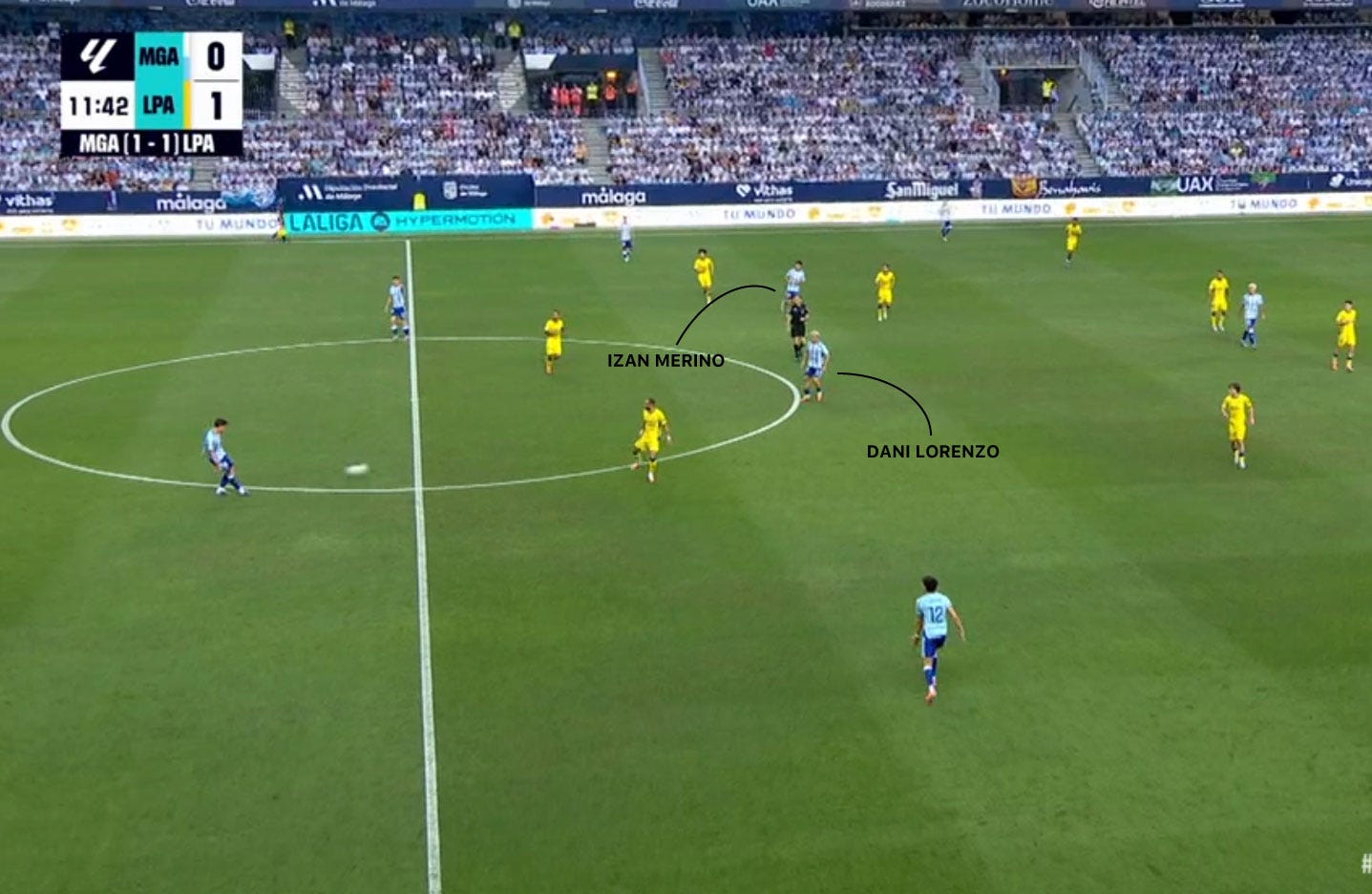
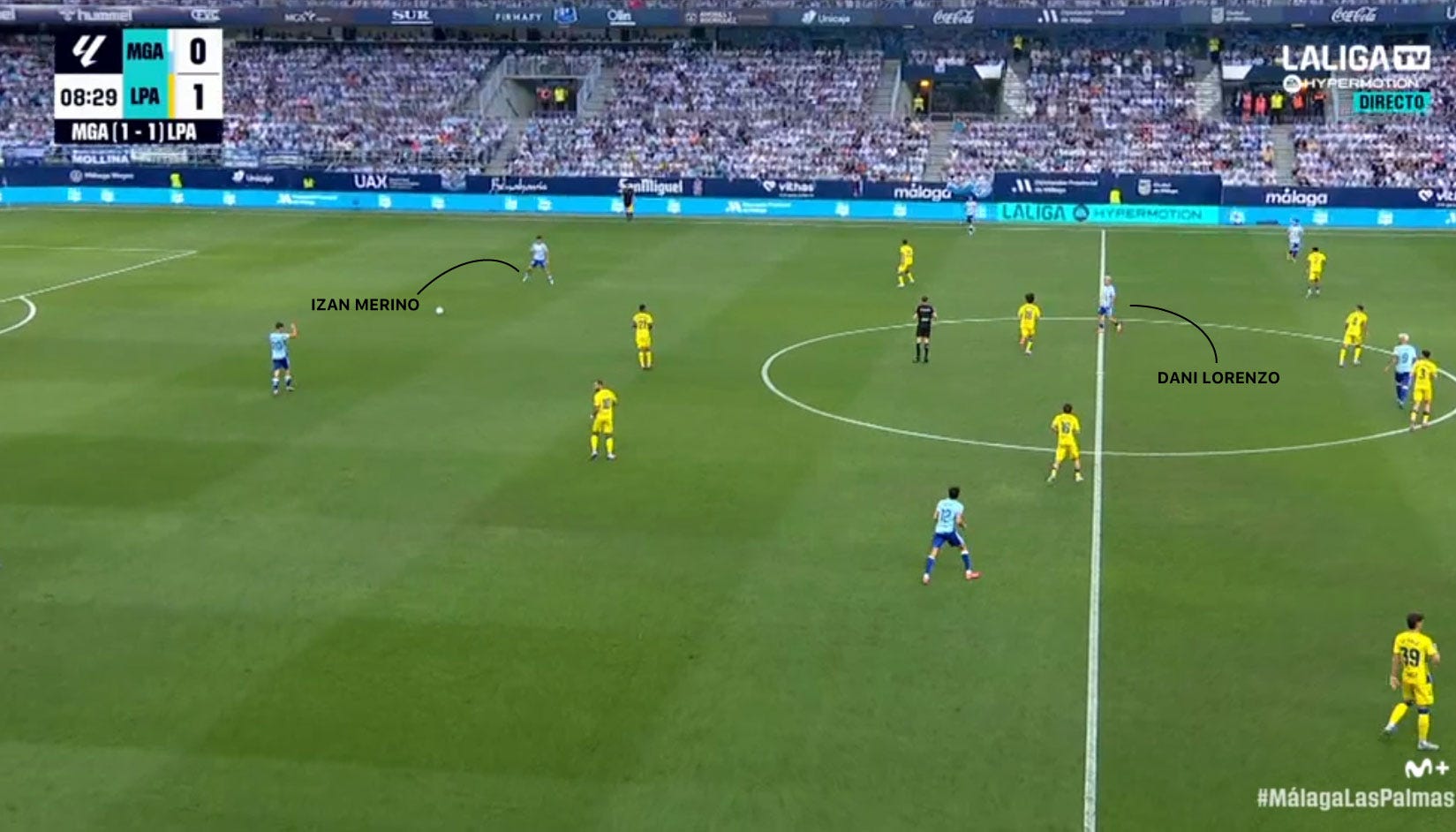
Lorenzo (#22 in the graphic below), a 23-year-old academy graduate, is crucial to that flexibility as he can play at almost every level. He can drop deep to support the first phase, move into the pivot position or advance between the lines. It is in those higher areas where he is most dangerous, receiving under pressure, turning in tight spaces and creating problems for opposition defences.
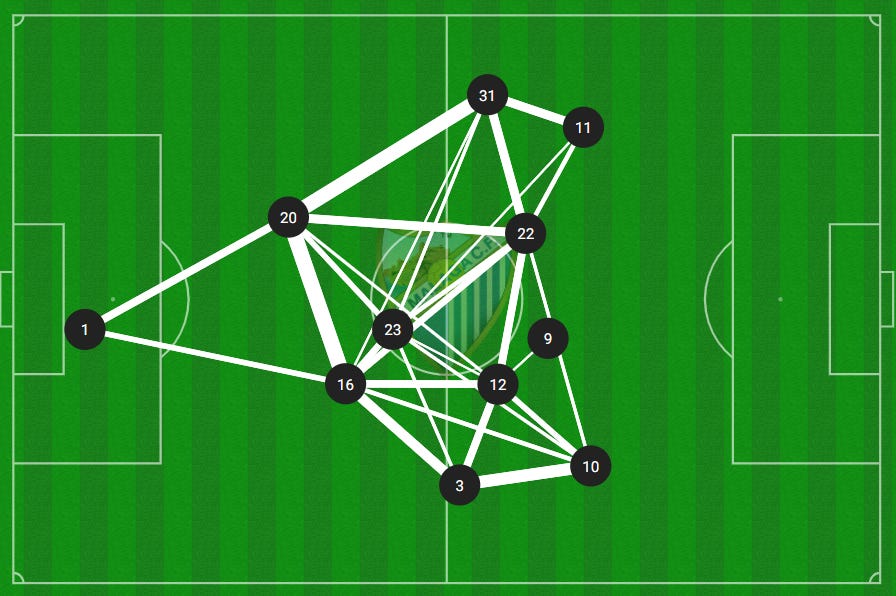
The approach suits the balance of the squad. Merino (#23 in the graphic above), another academy product at just 20, can organise the first phase of possession. Joaquín Muñoz, David Larrubia and Aarón Ochoa provide one-on-one threat in wide areas, while Chupe has the physical profile to act as a target for more direct attacks.
Málaga do not need to dominate the ball in one particular way. They can build through pressure, isolate defenders out wide or play directly into Chupe. Their strength lies in having several different routes towards goal and knowing when to use each one.
Without the ball, Funes uses the youthful exuberance of his team to press in a mid-high block. We saw this against Las Palmas, a team that boasts the technical ability of Mika Mármol, Lorenzo Amatucci, Kirian Rodríguez and Jonathan Viera but still couldn’t and didn’t dare break them down.
They are tied for third in high turnovers since Funes took charge (7.33 per game). They had been 12th under Pellicer. They want a game played on their terms and are aggressive in how they go about it. Funes, in that sense, is like a young Unai Emery. As competent in every phase as possible without relying too heavily on any single one. It means you can mix it with the best of the best but also dominate weaker teams who are willing to sit deeper.
Funes is a modern manager for a modern version of Málaga.
His and Málaga’s story this season doesn’t need promotion to be one of success but it deserves a happy ending.